
Tainter’s Theory of Complexity and Collapse
Joseph Tainter has developed a theory of why civilizations collapse. He describes this idea in a book entitled The Collapse of Complex Societies.
Very briefly, human societies continuously adapt to solve emergent problems. Generally, this problem-solving process involves increasing the complexity of their systems—adding administrative layers, specialized labor, and new infrastructure.
One my aphorisms goes something like “Every solution generates its own problems.” Generally when I spout this off, I get crickets in response. It turns out I’m not the only one who has noticed this. Google turns up a quote in which Arthur Bloch (whoever that is) is quoted as saying “Every solution brings new problems.” I like my version better, even if it basically says the same thing.
In Tainter’s model, increasing complexity inherently increases maintenance costs. The ice maker in a refrigerator solves the immediate problem of having ice on tap. (Why having ice on tap is an urgent problem is another question entirely.) However, adding that ice maker guarantees that sooner or later, the water supply line will leak, leaving you with water all over the floor and an expensive repair bill.
More broadly, maintaining systemic complexity requires continuous energy inputs. A society operates on a finite supply of available energy and resources. As it continuously adds complexity to solve new problems, it hits a point of diminishing marginal returns: the energy required to maintain the existing overhead consumes the available surplus. When a society uses all its available energy just to keep its existing systems running, its ability to address new, inevitable shocks breaks down.
When that happens, something has to give. Often that “something” is the entire structural apparatus—a process Tainter defines as a collapse, or the rapid loss of socio-political complexity.
Tainter’s canonical example is the Western Roman Empire, which collapsed into localized feudal lordships. In contrast, the Eastern Roman Empire survived for another thousand years as Byzantium.
Both regions ultimately shifted to lower-complexity systems, but through vastly different paths. In the West, the central Roman state vanished, forcing local populations to improvise new, highly fragmented feudal structures on their own. In Byzantium, the central state managed its own de-complexification.
In both cases, governance and defense shifted to regional control. Under Western feudalism, private lords assumed hereditary ownership of local land. Under the Byzantine Theme system, appointed military governors (strategoi) administered regional defense using free peasant farmer-soldiers, while the ultimate ownership of land and legal authority remained held by the sovereign state.
The Optimization Landscape
This dynamic maps neatly onto non-convex optimization theory.
In non-convex optimization, an algorithm searches a complex landscape containing multiple local “valleys” (local minima) separated by high “hills” (energy barriers).
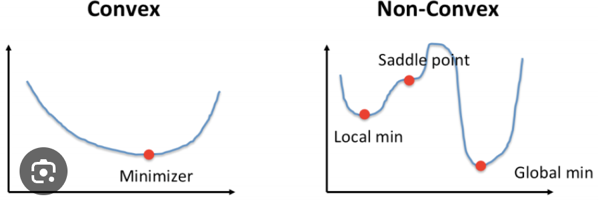

Imagine an ant crawling along a line on a non-convex curve. It takes a small step, comparing its new position to the previous one. If the new position is better (lower energy deficit), it keeps moving in that direction; otherwise, it changes course. Once it reaches a point where every adjacent step leads uphill, it has arrived at a local minimum. It may or may not be the optimal global solution, but from inside the valley, the ant has no way of observing the broader landscape.
In computational optimization, the standard method for escaping a bad local minimum is to introduce a sudden, random jump—throwing the ant into the air to start exploring a completely different part of the landscape.
A society attempting to adapt acts much like this ant, moving across a high-dimensional non-convex surface. Each incremental step toward solving a problem increases complexity and resource requirements. When the society exhausts its available surplus energy, every attempt to maintain the system forces it up an unsustainable hill.
What this static visual model doesn’t show is the landmine of systemic energy failure along those uphill steps. When a brittle society steps on one of those landmines, it experiences a collapse. The system is forcefully thrown out of its local valley, leaving what remains of the population to use the remnants of previous solutions to explore and find a new, sustainable baseline.
0 Comments